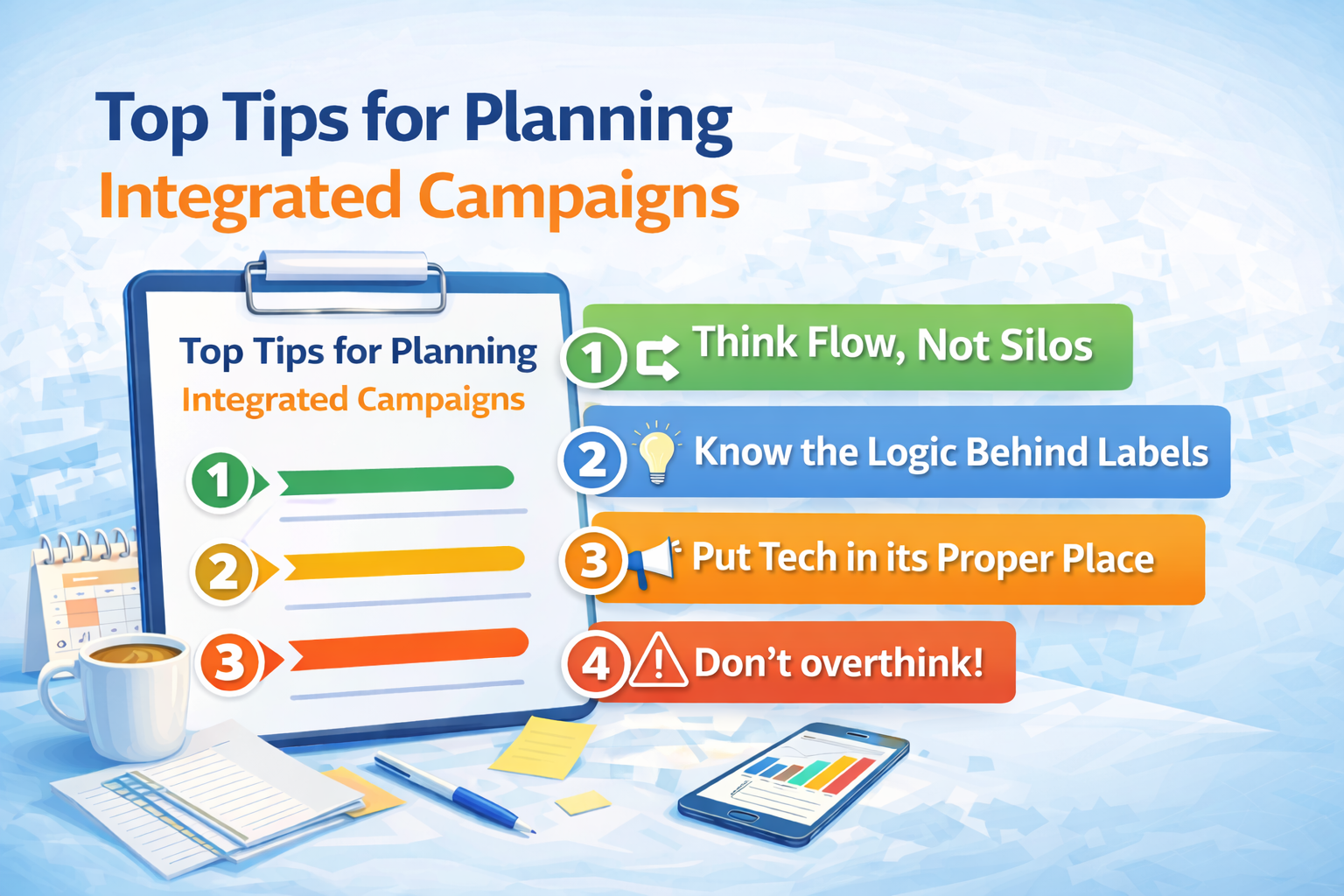
We asked Ann Prayle, our Planning Integrated Campaigns (a module on the CIM Certificate in Professional and Digital Marketing) tutor to say a few words of advice for students on the course. Here are her valuable words…….
“OK you’ve read what the promotional documents and module guide say about it, but let’s talk honestly about Planning Integrated Campaigns.
This module can feel like endless acronyms (that word in itself is hard to spell, never mind remembering all the things it relates to). It’s a lot of diagrams, lists, arrows going everywhere and a healthy dose of definitions.
In marketing, we love frameworks, but for students, with all of the above together, it can be stressful at times and make you feel like you’re drowning in word soup. But this module is actually one of the most practical ones you’ll do at Level 4 – if you study it the right way.
Here’s how I’d recommend approaching it so you are not A.O.T.P.
(All Over The Place and yes, I’ve just added another acronym to your list!)
1. Don’t treat the module as separate topics
One of the biggest mistakes students make is revising this module in little silos.
• Planning models over here.
• Segmentation over there.
• Content marketing somewhere else entirely.
• Metrics? Oh yes… those… tacked on at the end.
CIM absolutely does not see it that way – and neither should you.
Planning Integrated Campaigns is about flow:
from insight → through strategy → into execution → and finally measurement.
When you study, always ask yourself:
• What comes before this?
• What does this lead to?
• Why does this matter in a campaign?
If you can link topics together in your head, you’re studying the 3 C – studying it correctly, so you’ll therefore be using it correctly and remembering it correctly too.
(Sorry I have included here some arrows, lists and acronyms – in my defence, I have been teaching CIM a long time……).
2. Learn the planning logic, not just the labels
You will see a lot of familiar words like Objectives, Strategy, Tactics, KPIS, Channels and a load of others and the danger here is thinking “I know what those are” and moving on.
Instead, focus on:
• What decisions belong at each stage
• What shouldn’t happen yet
• What information is needed first
• What could come next
Perfect your planning knowledge like a planner with pain points to target and avoid picking through points without purpose….
3. Digital matters, but it isn’t the whole performance
Let’s debate digital.
Yes, digital is important.
Yes, it appears throughout the module.
However, no, the answer is not “do more digital”.
A lot of students fall into the trap of treating digital like the star of the show, when in reality it’s part of the supporting cast.
When you’re studying anything digital-related, keep asking:
• What role is this playing in the campaign?
• What problem is it solving?
• How does it link back to the objective?
Digital, data and AI are tools to support good planning and are not shortcuts around it.
If your thinking jumps straight to platforms, tools or tech without first grounding itself in insight and strategy, pause and rewind to improve your performance.
4. A final, quick word on overthinking (because it happens)
This module has a special talent for making students overthink.
Because there’s so much going on, it’s easy to:
• Try to remember everything
• Panic that you’ve missed “the right framework”
• End up down a rabbit hole
Here’s the rule:
If your thinking feels clear and logical, you’re probably on track.
If it feels tangled and complicated, you’ve probably gone too far.
Planning Integrated Campaigns rewards calm, joined-up thinking.
Follow these study tips and you will reap the rewards too.
Good luck!